CURRENTLY, THERE IS MUCH FOCUS ON CHANGING WORKPLACE ENVIRONMENTS AND WORKING PATTERNS AND AN UNCERTAINTY THAT SEEMS TO GO HAND-IN-HAND WITH EXCITEMENT AROUND WHAT THE FUTURE OF WORKING BRITAIN, AND INDEED, THE WORLD WILL LOOK LIKE
In light of this, Wave Office spoke to Julie Berdou, an Interior Designer in her early twenties. Having now completed her final year of BA (hons) Interior Design and Technology (Cass School of Art Architecture and Design at London Metropolitan University), Julie is excited by a future career in the field or the possibility of completing a masters programme and has shared the process behind her final projects with us.
One of Julie’s projects, WW A Mobile WorkPlace That Connects, is perhaps one of the most pivotal design ideas in expressing how future generations will choose to work and how the face of business will change. WW is Julie’s response to the RSA Student Design Awards and Tomorrow’s Workspace brief. The transparent work spaces are designed to be placed in busy areas and accessible to those who require an office space between meetings, to impress potential investors or customers and grab some extra publicity (there is an option to display your logo on the wall whilst you work there). With fixed office spaces set to become more of a rarity, WW also caters to those who can’t afford to rent space in places such as London but do spend a lot of business time there.
The concepts for the configuration of WW make sure that it meets Generation Y’s demands for:
- Connection (the Wall)
- Collaboration (the Fold Out Wall)
- Contemplation and focus (the X Work Wall)
- Community (Fixed Cube)
The design also takes into consideration what
consumers in Generation Y will and do demand. With social media an integral part of most marketing plans now, consumers expect to identify a brand’s personality, be able to interact with a company and to gain almost instantaneous answers. The most successful brands in recent years have pushed the boundaries in social media and created the opportunity for more affinity and brand recognition from consumers. Working at a WW workstation will give the impression that the company has nothing to hide, is flexible and up-to-date and is confident enough to allow people to see the faces behind a brand.
Julie also took into account the fact that the next working generation will place a high importance on energy efficiency and combating global warming. WW uses solar cell technology and LED lights among other features and a high level of material research was carried out. All of this was calculated and researched alongside the possible profits, the budget and the amount of noise pollution inside and outside of the hubs.
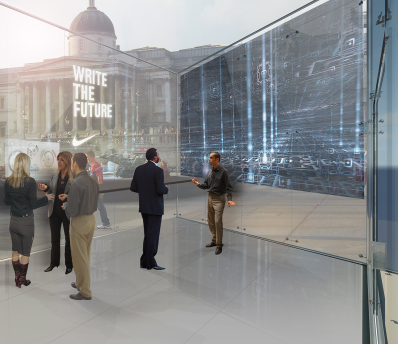
Perhaps an even bigger triumph for WW is that, as Julie discovered, these work spaces appeal to not just Generation Y, but their predecessors Knowledge Workers, Baby Boomers and Silver Talent who loved the concept and would be happy to work in such places. Finding this opportunity to blend the working generations is crucial during the crossover and will help troughs in morale and productivity. As Julie points out herself, the current and ongoing changes to the workforce are not without their issues:
“In terms of mobile working I think a challenge that needs to be overcome is how to establish trust between employees themselves. One employee not physically being in the office, but working on the go, could be seen by another as them not working at all (If I can’t see XYZ, XYZ is probably not working.). It’s up to HR, management and leadership to develop strategies that deal with such issues”
Another of Julie’s projects the Adaptive Workspace Hub was a response to abandoned architecture and dereliction; the application site is the former flour mill, Millenium Mills, West Silvertown.
The derelict flour mill is not only a reflection of Newham, an area currently dealing with deprivation, unemployment and youth violence, but also of the transition between working generations and the changes they will bring. Generation Y and those to come after will change the face and the mechanics of the workforce, just as Julie has done with Adaptive Workspace Hub.
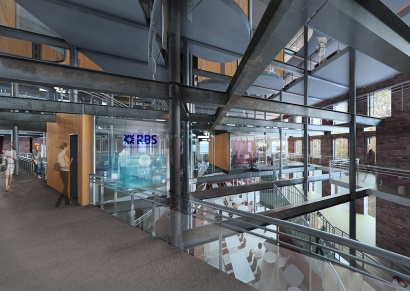
Julie’s aim with the Hub was to create a place designed to meet the needs of a multi-generational workforce, offering break-out and social areas with quiet, personal spaces for those seeking them. The result was a high segmentation and choice concept that allowed individuals to personalise their work style and provided areas that aided concentration, facilitated collaboration and provided an escape from work to recuperate, something Julie puts a high importance on herself:
“I achieve my best results when working in a physical environment that is adaptable to my needs. Sometimes I need to concentrate on a particular task, that’s when I need my personal desk, chair, laptop and a calm but personalised environment with a sense of ownership. Then I also need to interact with people, talk about my ideas. I want to get inspired by other peoples work and I also want to help inspire others with mine. Recuperation is immensely important too, there are only so many hours of working, concentrating and collaborating I can do before my brain shuts down and I need a break. I believe the workspace of the future should cater to these needs and respond with a series of adaptable workspaces that allow for people to concentrate, collaborate and contemplate when it is appropriate for them”
It’s a tough but exciting time for designers, leaders and employees alike, there are changes in practice and experience for all concerned and as Julie points out, “the physical working environment is only part of a complex matter leaders especially should recognise their workforce’s needs and characteristics in order to boost productivity”. “It is key that individuals can personalise their work style and work in a variety of ergonomic positions (seated, standing, reclining) that allow for a healthier work style”.
In fact, only recently a top Doctor Professor John Ashton has declared that britain should only be working a four day week to reduce stress. It is clear from this and the recent Government change to flexible working that health and a good work-life balance are key in achieving a harmonious and productive workplace and are key factors in a new era of business.
There is no denying that we are entering a new and influential period in our work lives and it will be almost impossible not to be affected by this. The bottom line from Julie is that:
“Gen Y has definitely had an impact on what I do in terms of a designer and is shaping the workforce and its design considerably”
To find out more about Julie's work connect with her on any of the following:
Twitter: @JulieBerdou LinkedIn: http://uk.linkedin.com/in/julieberdou
Behance: https://www.behance.net/julieberdou

 Perhaps an even bigger triumph for WW is that, as Julie discovered, these work spaces appeal to not just Generation Y, but their predecessors Knowledge Workers, Baby Boomers and Silver Talent who loved the concept and would be happy to work in such places. Finding this opportunity to blend the working generations is crucial during the crossover and will help troughs in morale and productivity. As Julie points out herself, the current and ongoing changes to the workforce are not without their issues:
 Julie’s aim with the Hub was to create a place designed to meet the needs of a multi-generational workforce, offering break-out and social areas with quiet, personal spaces for those seeking them. The result was a high segmentation and choice concept that allowed individuals to personalise their work style and provided areas that aided concentration, facilitated collaboration and provided an escape from work to recuperate, something Julie puts a high importance on herself: